
Nikon Coolscan color negative RAW scanning
Suggested Vuescan settings for scanning negative strips to RAW with Nikon Coolscan and the SA-21 strip film adapter.
Step 1: Scan to Vuescan RAW files.
Step 2: Make JPG files from Vuescan RAW files
Step 3 (Optional): Use the Vuescan RAW files with Negative Lab Pro
These settings are for use with Vuescan 9.7.90. Later versions may have problems with step 2 (memory getting filled up).
1. Scan to Vuescan RAW Files with Nikon Coolscan
It can be difficult to get the right colors from negatives. Especially old negatives. If you only want to scan your negatives one time you can scan to Vuescan “RAW” file. A Vuescan “RAW” file is the raw CCD data from the scanner. You can then re-process these files with different settings in Vuescan without having to actually scan the image again.
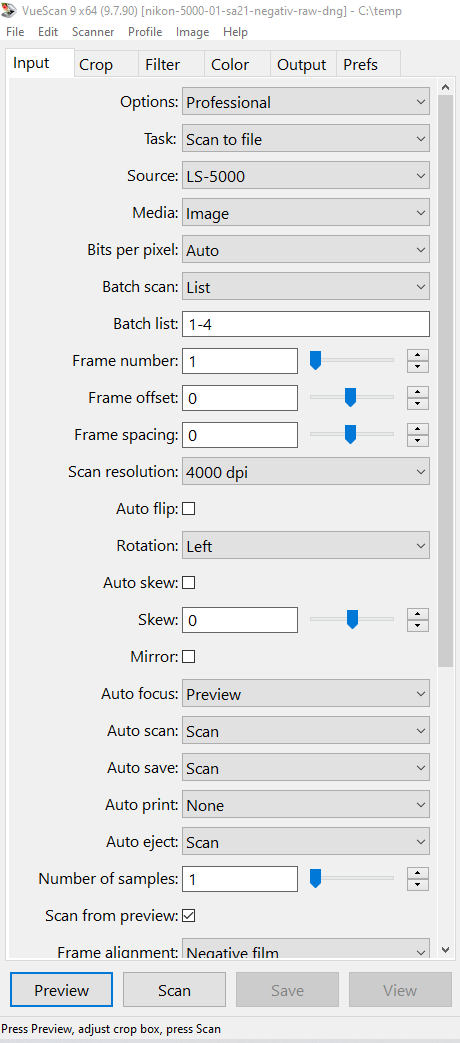

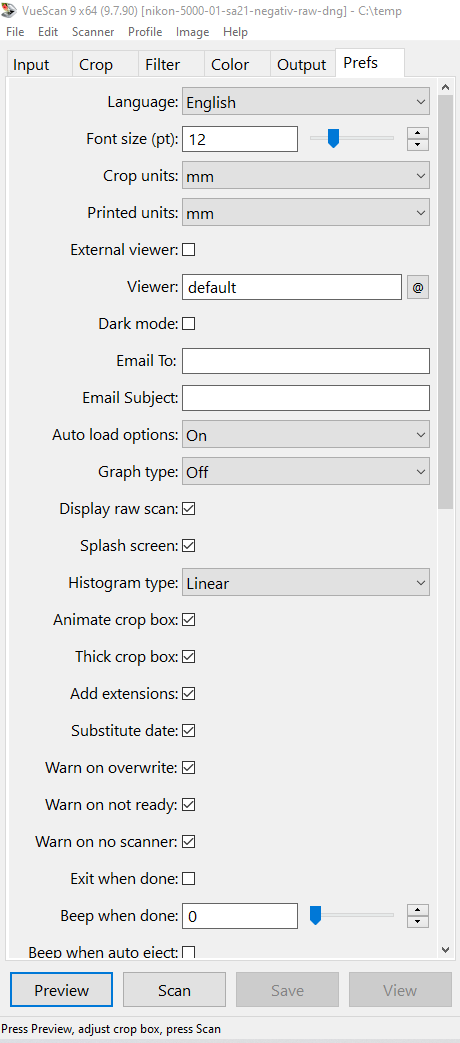
Input Tab
Media = Image ( also important if you want to use the scans with Negative Lab Pro ). Even though it is a “RAW” file the result is different if you use “Image” or “Negative”.
Batch list: Choose “1-4” if scanning 4 pictures on the strip
Auto Focus: preview (autofocus only on preview)
Auto Scan = Scan ( automatic start )
Auto Eject = Scan ( automatic eject after scan )
Scan from preview = on (this saves time, and because of the low contrast range in undeveloped negatives this works fine)
Crop Tab
Choose Crop = manual, x = 23, y = 35 (approx. values, use up and down arrows to adjust)
Auto Offset = on (this finds the corner of each image)
Border = – 0.8% or -1,2% (this will remove some of the border, but save you some manual cropping)
The idea is that the scanner should locate the corner of each picture (auto offset = on) and then crop it. This works usually fine, but if pictures are very unevenly spaced or even overlapping it does not work. If the film strip does not crop correctly try to feed in the opposite direction or split in smaller parts.
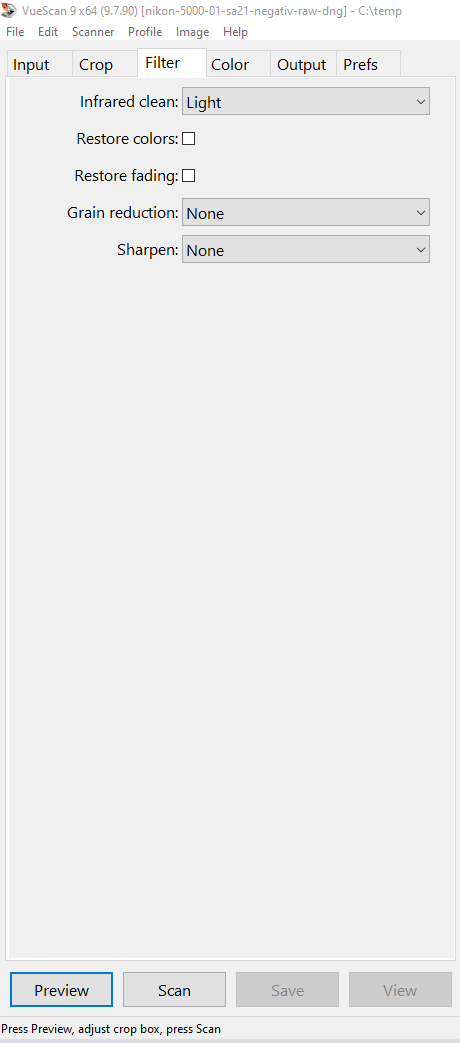
Filter Tab
Infrared Clean = Light (IR dust removal in the RAW file)
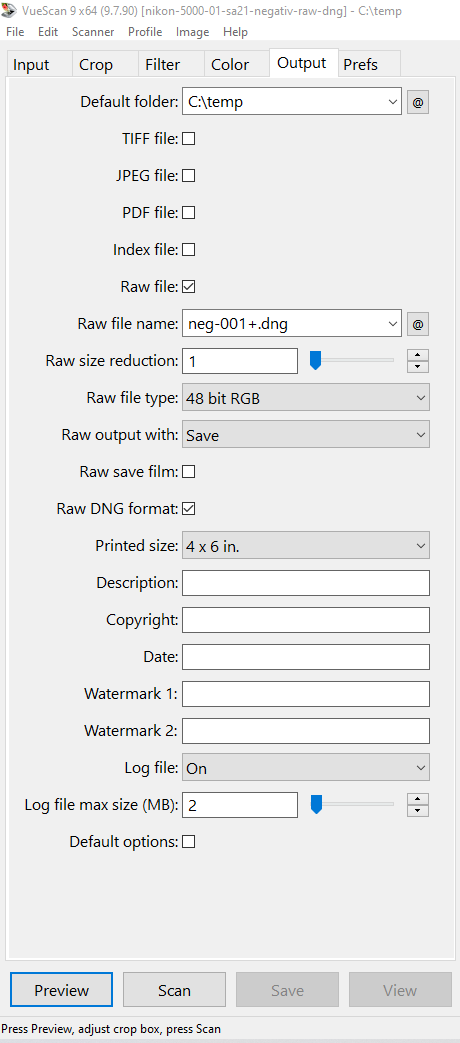
Output Tab
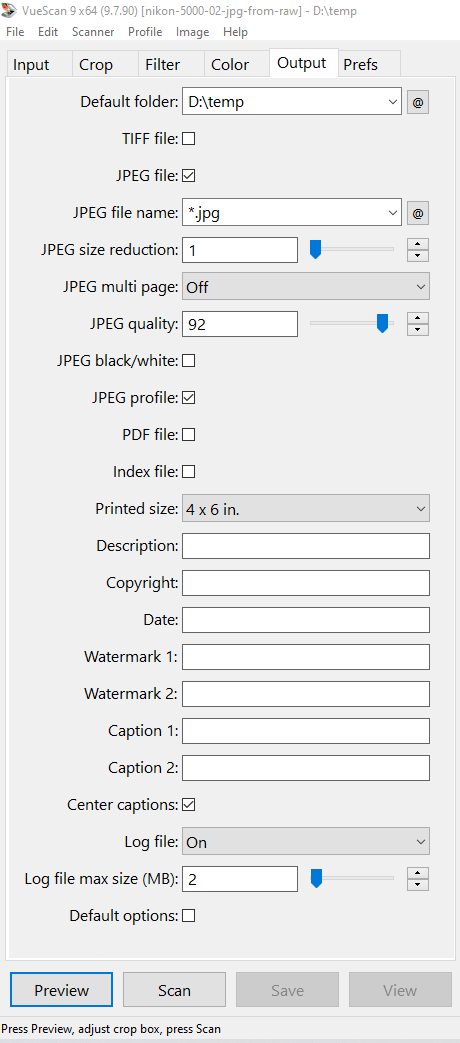
Raw Output with = Save (this means that RAW file is saved after IR dust removal)
Raw DNG format = On (You can use TIFF instead, but for use with NLP, DNG is recommended)
2. Make JPG files from Vuescan RAW Files
In the second step you make jpg files directly from the RAW files. If you want to try other settings you can change the settings and “rescan” the RAW files. If the films are in good shape this will give a fine result.
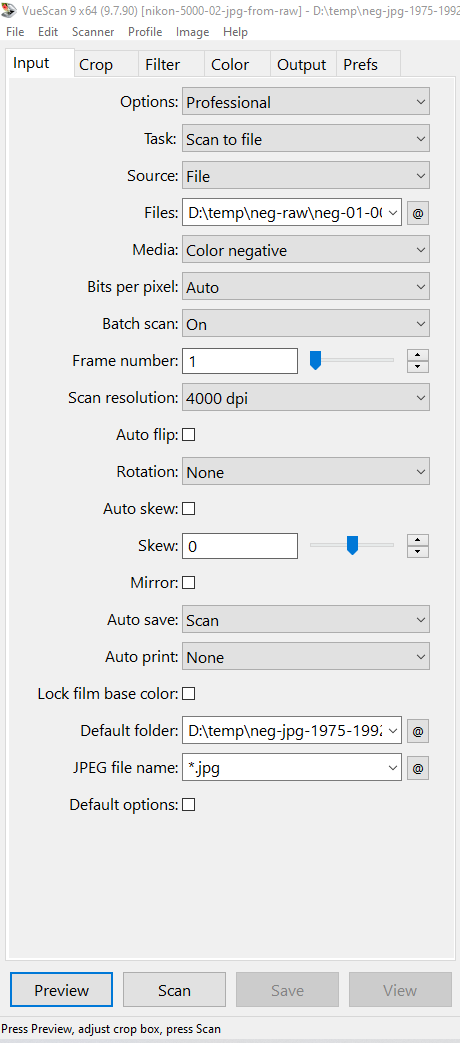
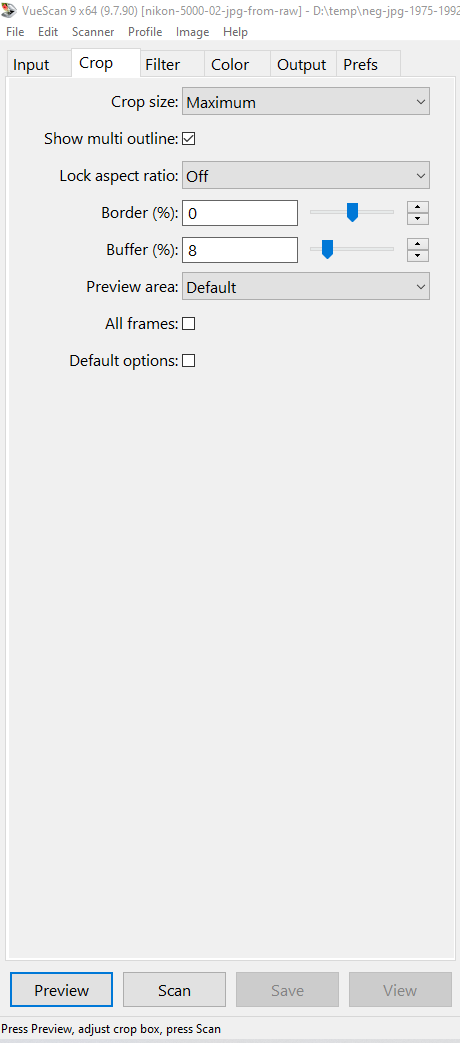
Input Tab
Files, go to the the directory with the RAW files and select (CTRL+A) all the RAW files
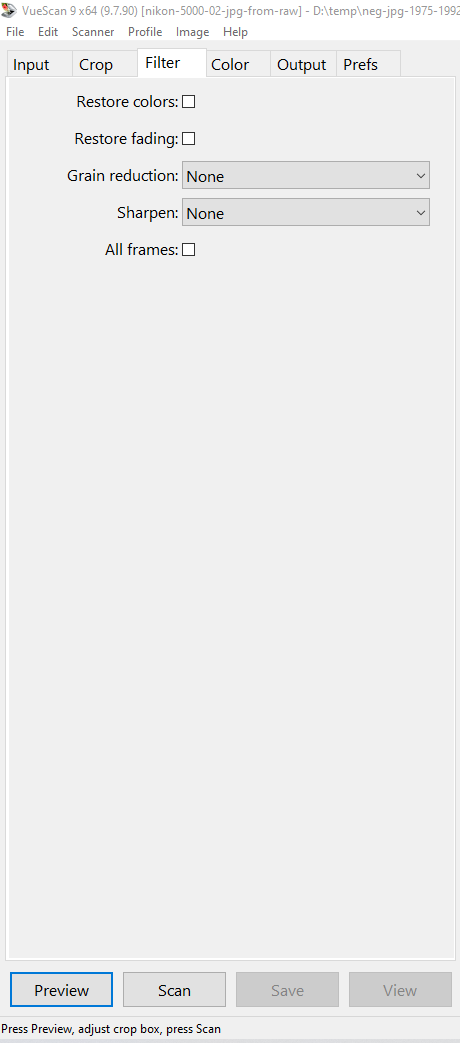
Filter Tab
Restore fading: Try Restore fading = “on” if your pictures are changed in color. If your pictures have good colors keep it off. Restore fading must be used together with Color balance = Neutral.
Sharpen: Choose “sharpen = off” for the most natural look. Choose “sharpen = on” if you prefer a little more sharpness, but it will look less natural.
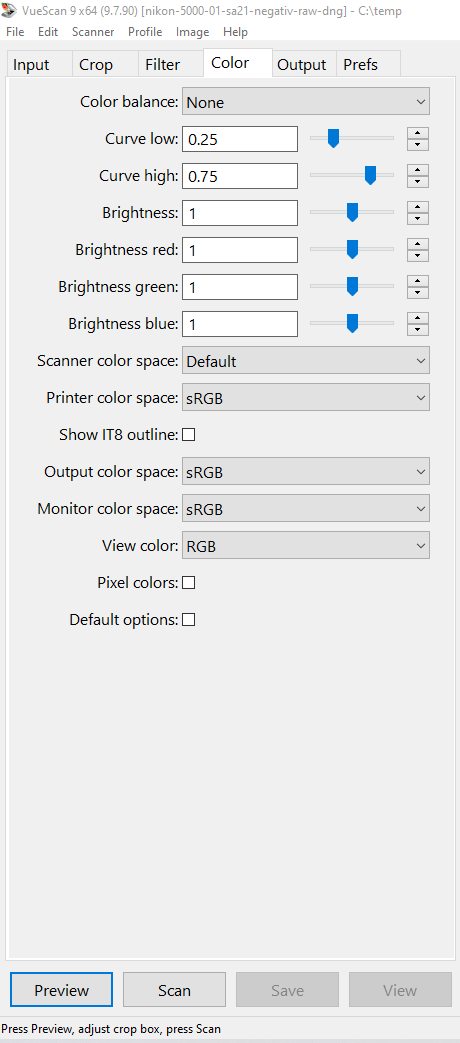
Color tab
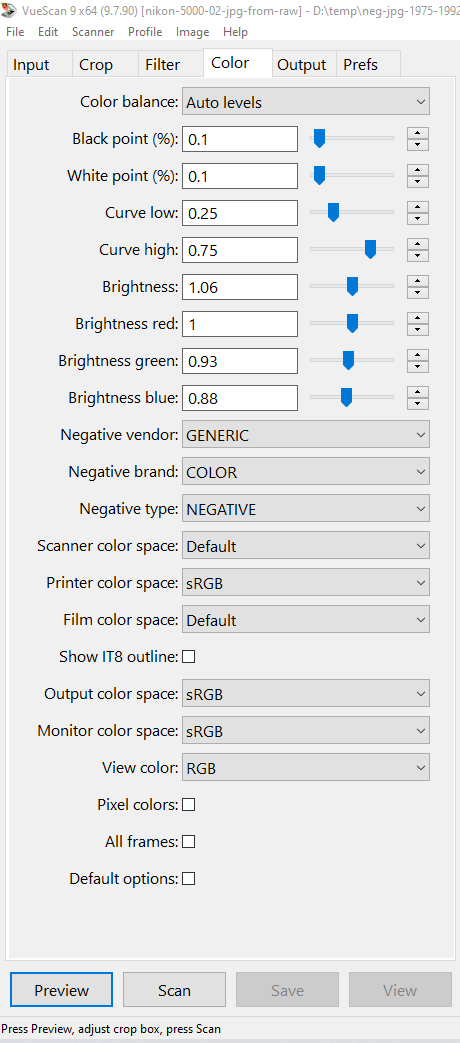
Color balance = “Autolevels” will correct some color cast. Or you can choose “Neutral” if you pictures has good colours.
Black Point: Default Value is 0, however this gives the picture a washed out look. Choose 0.1
White Point: The default Value is 1, meaning that 1% of the pixels is made pure white, this removes a lot of detail in the light. Choose 0.1
Curve Low, Curve High: If you want greater contrast try Curve Low = 0.30 and Curve High = 0,70, but you will lose some detail in the dark parts. To view the curve choose “image”, “graph curve”.
Brightness = 1.06, red = 1, green = 0.93, blue = 0.88 ( this is a color temperature of 5500K giving a slightly warmer look, or you can just leave these 4 settings at 1 (default).
Negative Vendor = “Generic” or choose film type.
3. Vuescan RAW files and Negative Lab Pro
You can convert the Vuescan RAW files to JPG files with Negative Lab Pro Software. This is only recommended for advanced users. Negative Lab Pro is a plugin for Lightroom.
In Negative Lab Pro you have more control over the conversion and can often get acceptable results also from old color shiftet negatives. Also in Negative Lab Pro some of the settings are giving a more contrasty “Lab” look (like paper prints from a photo lab), if you prefer that. In many cases however the results directly from Vuescan is better. For the optimal result you can try both and compare the pictures.
The Vuescan RAW files for use in NLP must have the Media= Image setting (if not red color will be off), and Raw DNG Format = on.
Read more here
https://www.negativelabpro.com/guide/scanning/#vuescan-raw-dngs
https://www.negativelabpro.com/
(c) DataNord ApS 2026